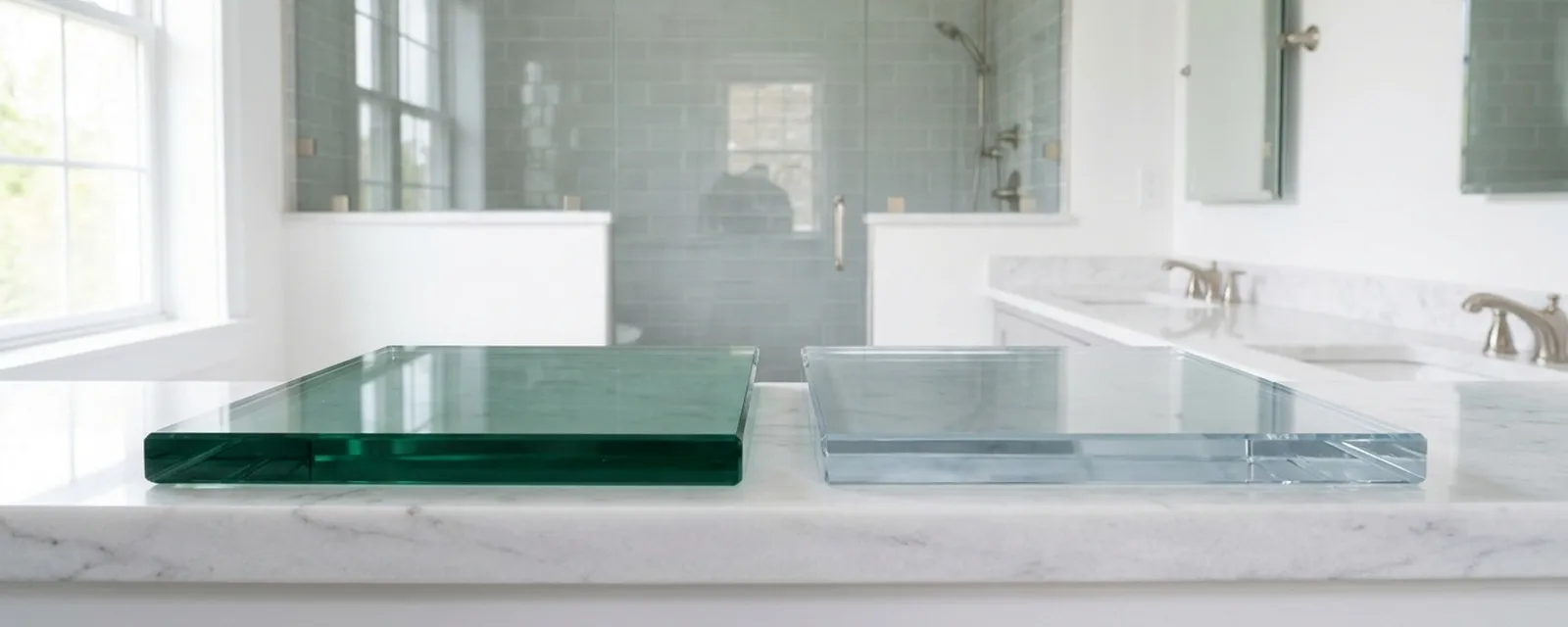
When you choose glass for a shower enclosure, you'll often be asked whether you want standard clear glass or low-iron glass. Both are transparent, both can be tempered for safety, and both work well in a shower. The difference is mainly about color and clarity, and it becomes more noticeable as glass gets thicker. This guide explains what low-iron glass is, how it compares to standard clear glass, and how to decide which is right for your bathroom.
Why "Clear" Glass Isn't Perfectly Clear
Standard clear glass, often called clear float glass, is made mostly from silica sand along with other raw materials. Those materials naturally contain small amounts of iron. The iron gives the glass a faint green tint.
Vitro Architectural Glass, a major North American glass manufacturer, puts it this way: clear glass isn't completely clear—it has a distinct green hue when viewed under light.
Where You Notice the Tint
You may barely notice the tint when looking straight through a thin window. It becomes more visible:
- At the edges. Looking at a glass edge means looking through the full width of the glass, which concentrates the color.
- In thicker glass. Frameless shower glass is typically 3/8 or 1/2 inch thick, much thicker than a standard window pane.
- Against white or light-colored surfaces. White tile, marble, or light stone can make a green tint more apparent.
What Is Low-Iron Glass?
Low-iron glass is made with raw materials that contain much less iron. According to Vitro, low-iron glass is made from silica with a significantly reduced iron oxide content—about 0.01%, roughly one-tenth that of standard float glass. Vitro explains that it is made using primarily high-purity silica sand, which is then processed using the standard float glass method.
The result is glass that looks noticeably more neutral. You may hear it called "ultra-clear," "optically clear," "extra-clear," or "water white." Many manufacturers make low-iron glass under their own brand names. Vitro's version is called Starphire Ultra-Clear glass.
The Edge Color
Low-iron glass isn't completely colorless at the edge either, but the tint is different. Vitro notes that even at thicknesses up to ¾ inch, low-iron glass remains clear with a distinctive azure-blue edge. Many homeowners find this lighter, cooler edge less noticeable than the green edge of standard clear glass.
Light Transmission: What the Numbers Show
Visible light transmittance (VLT) measures how much visible light passes through glass. Higher numbers mean more light gets through.
Vitro publishes a comparison between its standard clear glass and Starphire low-iron glass at two thicknesses:
| Glass | Thickness | Visible Light Transmittance |
|---|---|---|
| Clear glass | 1/8" | 90% |
| Clear glass | 3/4" | 83% |
| Starphire low-iron glass | 1/8" | 91% |
| Starphire low-iron glass | 3/4" | 90% |
Source: Vitro Architectural Glass
What This Means
At 1/8 inch, the difference is small: 91% versus 90%. At 3/4 inch, the gap widens to 90% versus 83%. Vitro explains that while the inherent green tint of conventional clear glass amplifies as thickness increases, with low-iron glass, that amplification is less pronounced.
Shower glass falls between these two published thicknesses, so its exact figures will depend on the product. The general pattern holds, though: the thicker the glass, the more difference low-iron makes.
What Low-Iron Glass Does Not Change
It's helpful to know what low-iron glass is not.
It Isn't Stronger
Low-iron glass is about clarity, not strength. Shower glass should be tempered safety glass whether it's clear or low-iron. Tempering is what provides the safety performance.
It Isn't the Same as Low-E Glass
The names sound similar, but low-E (low-emissivity) glass has a thin coating designed for energy performance in windows. Low-iron glass refers to the glass's raw material composition. They are different products used for different purposes.
It Doesn't Prevent Water Spots
Low-iron glass doesn't resist hard water or soap scum any better than standard glass. Cleaning and maintenance are the same. Protective coatings are a separate option.
Cost and Availability
Low-iron glass is generally priced as a premium product; Vitro describes it as a premium glass type. Actual pricing depends on the glass thickness, size, fabrication, and supplier, so get a specific quote for your project rather than relying on general rules of thumb. Availability can also vary by thickness and fabricator.
How to Decide
Low-Iron Glass May Be Worth Considering If:
- You're using thick glass (3/8 or 1/2 inch) with exposed edges
- Your bathroom features white, light gray, or natural stone tile
- You want tile colors and patterns to look as true as possible through the glass
- You prefer the most neutral, "invisible" glass appearance
- Your enclosure has large panels, where tint is more visible
Standard Clear Glass May Be Fine If:
- Budget is a priority
- Your tile is darker or warmer in tone, which can make a slight green tint less noticeable
- The glass edges aren't prominent in the design
- You're not bothered by a subtle green edge
See It Before You Choose
The difference is easiest to judge in person. If possible, look at samples of both glass types side by side, ideally against a sample of your tile. Check the edges as well as the face of the glass.
Frequently Asked Questions
Is low-iron glass the same as Starphire?
Starphire is Vitro's brand name for its low-iron glass. Other manufacturers make low-iron glass under different names.
Can low-iron glass be tempered?
Yes. Low-iron glass can be tempered for use in showers, just like standard clear glass.
Will I notice the difference with frameless shower glass?
Many people do, especially at the edges and against light-colored tile, because frameless shower glass is relatively thick.
Is low-iron glass harder to clean?
No. It cleans the same way as standard glass.
Does low-iron glass let in more light?
Yes, somewhat. According to Vitro's published figures, the difference grows with thickness: one percentage point at 1/8 inch and seven at 3/4 inch.
If you'd like help comparing glass types for your shower, TruePane Glass is happy to answer questions.
Sources
- Vitro Architectural Glass, "Low-Iron Glass": www.vitroglazings.com