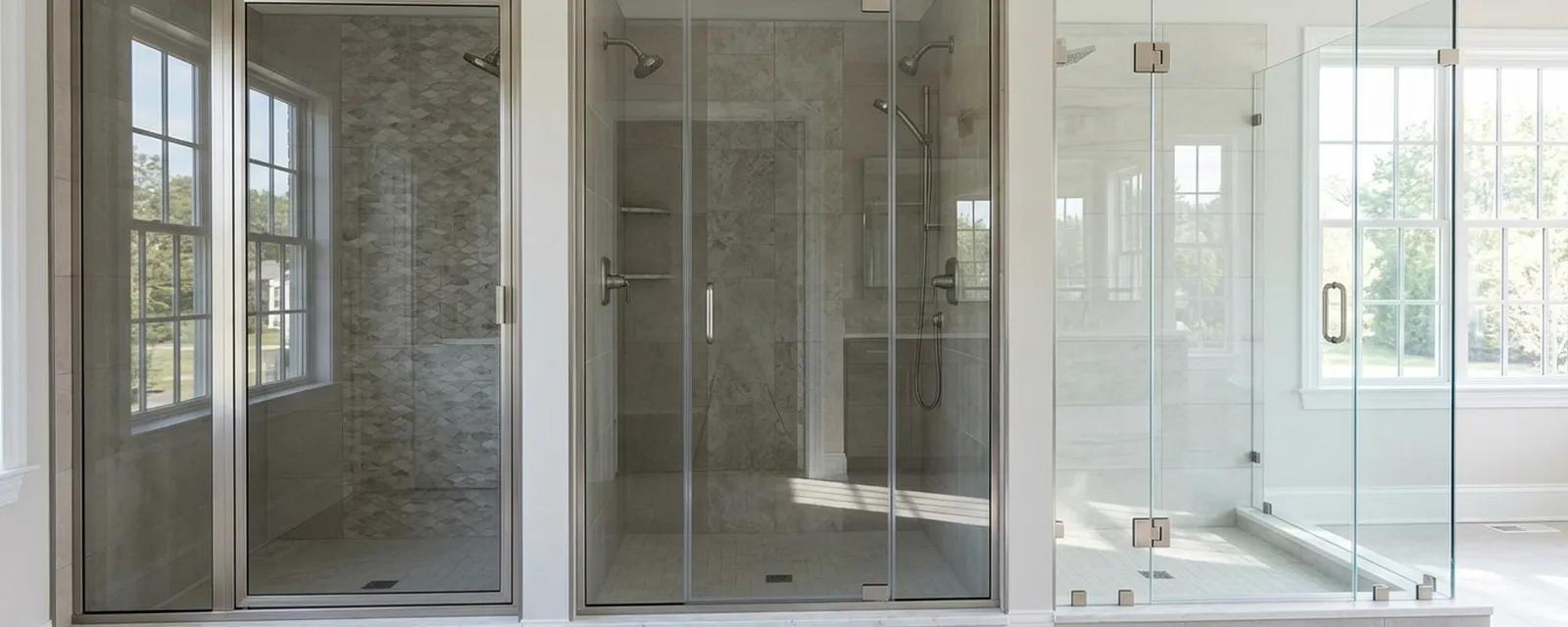
If you're replacing a shower curtain or an old door, you'll quickly run into three terms: framed, semi-frameless, and frameless. They describe how much metal surrounds and supports the glass. That one difference affects how the door looks, how it's built, how it's cleaned, and how well it suits your bathroom's layout. This guide explains each style in plain terms so you can compare them with confidence.
The Basic Difference: Where the Support Comes From
Every glass shower enclosure needs something to hold the glass rigid and in place. The three styles answer that need in different ways.
- Framed doors get their support from a metal frame around the glass.
- Frameless doors get their support from thicker glass, held by small hinges, clips, or brackets.
- Semi-frameless doors use a mix of both.
In general, a framed shower door wraps the glass edges in an aluminum channel and uses thinner glass because the frame provides structural support; Glass Doctor notes framed enclosures typically use 3/16-inch glass, semi-frameless usually 1/4-inch, and frameless 3/8-inch or 1/2-inch tempered glass.
Framed Shower Doors
How They're Built
A framed door has metal, usually aluminum, around the edges of every glass panel, including the door itself. According to Glass Doctor, the most common version is typically seen on a bypass shower door, which has two doors that slide in a frame mounted to the bathtub. Because the frame carries much of the structural load, the glass can be thinner.
Advantages
- Budget-friendly. Framed enclosures are generally the most economical of the three styles, largely because they use thinner glass and standardized parts.
- Water containment. The continuous frame and its seals give water fewer paths to escape.
- Forgiving fit. Frames and tracks can help compensate for walls that aren't perfectly straight.
- Good for tub-showers. Sliding framed doors are a common, practical choice over bathtubs.
Drawbacks
- More visual clutter. The metal frame breaks up the view and makes a bathroom feel smaller.
- More places for buildup. Channels, tracks, and joints collect soap scum, water, and mineral deposits, and can be harder to clean thoroughly.
- Dated look for some tastes, depending on the bathroom's design.
Frameless Shower Doors
How They're Built
Frameless doors have no metal frame bonded to the edges of the glass. The glass is thick enough to stand on its own and is held in place by hinges, clamps, or small channels. Glass Doctor notes that frameless enclosures use either 3/8 inch or 1/2 inch tempered glass.
The term can be a little confusing, because frameless enclosures still use some hardware. In the glass industry, Glass Doctor explains, "frameless" refers to any shower enclosure that does not have metal adhered to the edge of the glass, and the use of clips, u-channels, or a header does not disqualify a shower enclosure from actually being "frameless".
Advantages
- Open, clean appearance. Minimal hardware lets the tile, fixtures, and space show through, which can make a bathroom feel larger.
- Easier surface cleaning. With fewer tracks and channels, there are fewer places for grime to hide. (You'll still need to squeegee and clean the glass itself.)
- Solid feel. Thicker glass feels substantial when you open and close the door.
- Design flexibility. Frameless glass can be custom-cut for many layouts, including steam showers, knee walls, and walk-in designs.
Drawbacks
- Higher cost. Thicker glass, heavier hardware, and custom fabrication typically make frameless the most expensive option.
- Precise installation required. Heavy glass panels must be anchored securely into solid backing, and the walls and curb need to be close to plumb and level. This is generally a job for experienced installers.
- Small gaps. Because frameless doors swing freely without a full frame, there are small gaps along the edges. Seals and sweeps reduce them, but proper shower design (showerhead placement and a correctly sloped floor) also matters for keeping water in.
Semi-Frameless Shower Doors
How They're Built
Semi-frameless sits between the other two. Some edges of the glass are exposed, while framing remains in other areas. A common arrangement, per Glass Doctor, is one where there will be no metal across the top and the strike side of the actual shower door, and these enclosures usually use 1/4 inch tempered glass as well as a sleeker profile channel.
An Important Caveat
"Semi-frameless" means different things to different manufacturers. One door retailer points out that semi-frameless is a confusing term and one that is not an industry standard. Shower manufacturer ANZZI likewise describes models that may have framed fixed panels with a less-framed moving door, a header without a full door frame, or other combinations. When comparing semi-frameless products, look at exactly which edges are framed and what glass thickness is used rather than relying on the label alone.
Advantages
- Cleaner look than framed, with less visible metal.
- Usually less expensive than frameless, thanks to thinner glass and simpler hardware.
- Some structural help from the frame, which can make it suitable for layouts where full frameless isn't practical.
Drawbacks
- Still has some tracks and channels to clean.
- Inconsistent definitions make product comparisons harder.
Side-by-Side Comparison
| Feature | Framed | Semi-Frameless | Frameless |
|---|---|---|---|
| Visible metal | Around all glass edges | Partial | Minimal hardware only |
| Typical glass thickness | 3/16" to 1/4" | Commonly 1/4" | 3/8" or 1/2" |
| Look | Traditional | In between | Open, minimal |
| Cleaning | Most tracks and joints | Some tracks | Fewest hidden areas |
| Relative cost | Lowest | Middle | Highest |
| Installation | Most forgiving of out-of-plumb walls | Moderate | Most precise |
Glass thickness ranges above reflect common industry practice; actual thickness depends on the specific product and engineering.
How to Choose
Consider these questions:
- What's your budget? If cost is the main factor, framed or semi-frameless is usually the practical choice.
- What look do you want? If you want an open, modern bathroom, frameless delivers the cleanest appearance.
- Is it a tub or a walk-in shower? Sliding framed or semi-frameless doors are common over tubs; frameless is popular for walk-in showers and custom layouts.
- How much cleaning are you willing to do? Fewer tracks generally mean easier maintenance.
- What's the condition of your walls? Out-of-plumb walls or limited wall backing may affect which options are practical.
Frequently Asked Questions
Is frameless glass safe?
Shower door glass of any style should be tempered safety glass. Tempered glass is much stronger than ordinary glass and, if it does break, breaks into small pieces rather than large sharp shards.
Do frameless doors leak more than framed doors?
Frameless doors have small edge gaps that framed doors don't, so they rely more on seals, sweeps, and good shower design to contain water. A well-planned frameless shower can perform very well.
Can I install a frameless door over a bathtub?
Yes, fixed panels and hinged frameless doors are available for tubs, though the tub edge and walls must be able to support the hardware.
Is semi-frameless the same everywhere?
No. The term isn't standardized, so compare specific features and glass thickness between products.
Which style is easiest to keep clean?
Frameless typically has the fewest tracks and channels, which makes it easier to keep clean, though all glass needs regular squeegeeing.
If you're weighing these options for your own bathroom, TruePane Glass is happy to answer questions.
Sources
- Glass Doctor, "Defining Framed and Frameless Shower Enclosures": glassdoctor.com
- Reflect Window & Door, "Frameless vs Framed Shower Doors: Pros and Cons": www.reflectwindow.com
- ANZZI, "Framed vs Semi-Frameless vs Frameless Shower Doors": anzzi.com