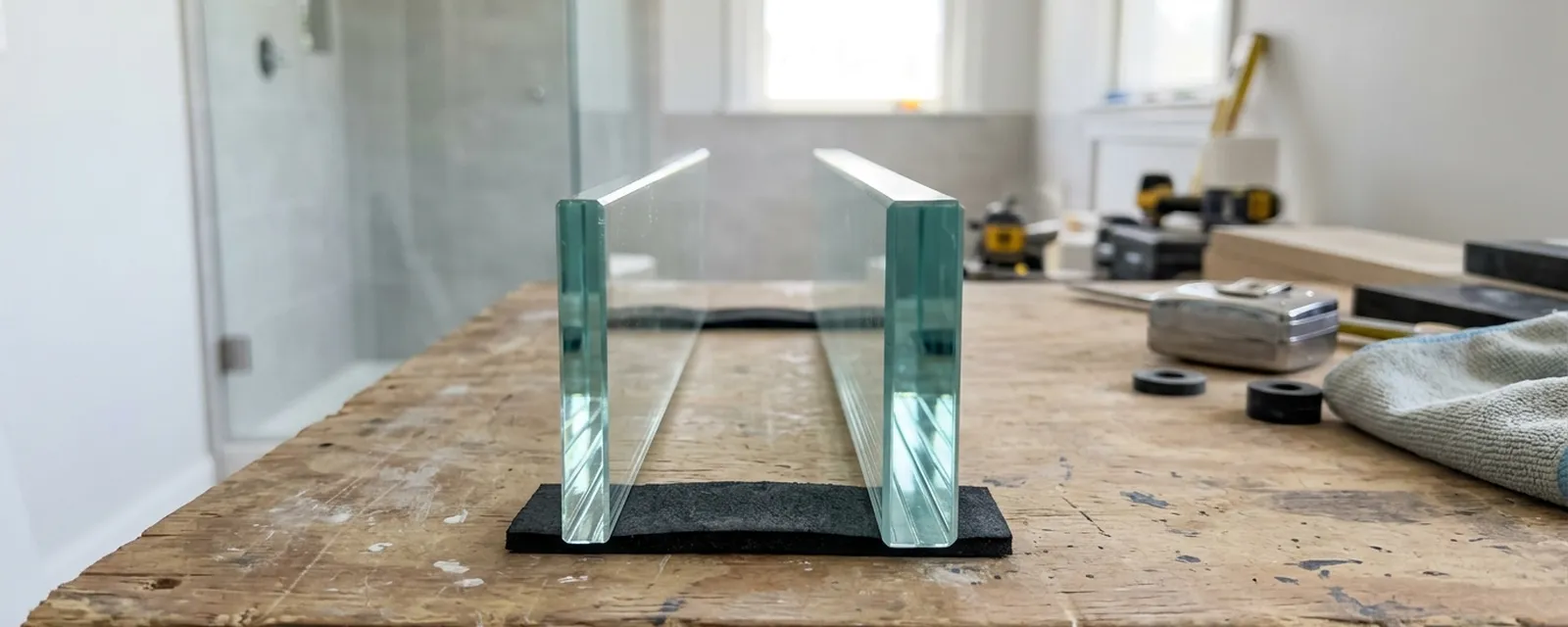
When you shop for a frameless shower enclosure, you'll usually be offered two glass thicknesses: 3/8 inch and 1/2 inch. Both are common, both are strong when properly tempered, and both can look great. But they aren't interchangeable in every situation. This guide explains what changes when you step up in thickness, and what doesn't, so you can make an informed choice.
Why Frameless Glass Is Thicker in the First Place
Framed shower doors can use thin glass because a metal frame supports every edge. Frameless enclosures don't have that frame, so the glass itself has to provide the rigidity. That's why frameless designs use much thicker glass than framed ones. Glass Doctor notes that frameless enclosures use either 3/8 inch or 1/2 inch tempered glass.
Nominal vs. Metric Sizes
Glass is sold under "thickness designations." In the National Glass Association's published table, 3/8 inch corresponds to 10 mm and 1/2 inch corresponds to 12 mm. These are trade designations rather than exact conversions (3/8 inch is 9.525 mm and 1/2 inch is 12.7 mm). You may see either measurement on quotes or product listings.
Weight: The Biggest Practical Difference
Thicker glass is heavier, and in a shower enclosure, weight affects nearly everything else: hinges, wall anchoring, installation, and how the door feels.
How Much Heavier?
The National Glass Association's technical paper on approximate glass weights lists 3/8 (10.0) at 5.0 lb/ft² and 1/2 (12.0) at 6.4 lb/ft². That makes 1/2-inch glass roughly 28% heavier per square foot than 3/8-inch glass.
To put that in perspective, here's simple arithmetic using those published figures for a door panel measuring 30 inches wide by 72 inches tall (15 square feet):
- 3/8-inch: about 75 pounds
- 1/2-inch: about 96 pounds
These are approximations for illustration. Actual weight depends on exact dimensions, cutouts, and the specific product. The same NGA paper notes that if the exact thickness is known, the exact weight may be calculated using a glass density of 158 lb/ft³. Tempering doesn't change the weight; it changes the glass's strength, not its density.
Why Weight Matters
- Hinges: Shower door hinges are rated for maximum door weight and width. A heavier door needs hinges rated to carry it, and may need more hinges.
- Wall support: Hinges and clamps must anchor into solid blocking or studs. Heavier glass places more load on those connections.
- Installation: Larger, heavier panels are harder to handle safely and may require additional installers.
- Long-term wear: Hardware carrying a heavy door works harder every time the door opens and closes. Properly matched hardware is essential.
Strength and Safety
Tempering, Not Thickness, Is the Safety Feature
It's common to assume thicker glass is "safer." In a shower, the key safety feature is that the glass is tempered. Dulles Glass puts it plainly: tempering, not thickness, is what makes the glass shower-safe. Both 3/8-inch and 1/2-inch tempered glass are used safely in residential showers every day.
Stiffness and Flex
Thicker glass is stiffer. Over a given span, a 1/2-inch panel flexes less than a 3/8-inch panel. For most standard-size doors and panels, 3/8-inch glass has ample rigidity. Dulles Glass describes thickness as a structural decision, not a cosmetic one, explaining that it determines how wide the panel can span without noticeable flex, how much load the wall anchors carry, and whether the glass can support its own weight without a header or frame.
That's where 1/2-inch glass can earn its place: unusually tall or wide panels, or designs with minimal support such as a tall fixed panel held only at the base.
Look and Feel
Edge Appearance
Thicker glass has a more substantial edge, which some homeowners like for a high-end look. It also has a slightly more noticeable color at the edge. Standard clear glass contains iron, which gives it a faint green tint that becomes more visible as the glass gets thicker and when you look through the edge. If that tint bothers you, low-iron glass is an option at either thickness.
Door Feel
A heavier door feels more solid when you open and close it. Some people love that; others find a lighter 3/8-inch door easier to use daily, especially children or anyone with limited grip strength.
Hardware Compatibility
Hinges, clamps, handles, and seals are made for specific glass thicknesses. A seal designed for 3/8-inch glass won't fit 1/2-inch glass, and some hinge models are available only for certain thicknesses. If you're replacing a door, matching the original glass thickness can make it easier to reuse hardware or find compatible parts. If you're designing a new enclosure, hardware selection and glass thickness should be planned together.
When 3/8-Inch Glass Makes Sense
- Standard-size doors and fixed panels
- Bathrooms where a lighter door is easier for everyday use
- Walls where blocking is adequate but not heavy-duty
- Projects where budget matters, since thinner glass generally costs less and needs less substantial hardware
Dulles Glass describes 3/8 inch as the standard for frameless fixed shower panels.
When 1/2-Inch Glass Makes Sense
- Very tall or wide panels where extra stiffness helps
- Designs with minimal hardware, such as tall fixed panels with limited support
- Homeowners who want a heavier, more substantial look and feel
- Projects where the structural engineering or hardware manufacturer calls for it
What Doesn't Change
Regardless of thickness:
- The glass should be tempered safety glass.
- Cleaning and maintenance are the same.
- Water containment depends on seals, layout, and floor slope, not glass thickness.
- Proper installation into solid backing is essential.
Frequently Asked Questions
Is 1/2-inch glass safer than 3/8-inch?
Both are safe for showers when tempered and properly installed. Thicker glass is stiffer, but tempering is the primary safety feature.
Will 1/2-inch glass leak less?
No. Water containment depends on seals, door gaps, showerhead placement, and floor slope.
Can I swap a 3/8-inch door for a 1/2-inch door?
Possibly, but the hinges, seals, and wall support need to be rated for the heavier door. Existing hardware usually won't fit.
Does thicker glass look greener?
Standard clear glass shows more tint at greater thickness, especially at the edges. Low-iron glass reduces that tint.
Is 1/2-inch glass worth it?
It depends on the panel sizes, design, and the look you want. For many standard showers, 3/8-inch glass performs very well.
If you're deciding between glass thicknesses for your shower, TruePane Glass is glad to answer questions.
Sources
- National Glass Association, Glass Technical Paper FM01-08, "Approximate Weight of Architectural Flat Glass" (2020 edition): www.glass.org
- Dulles Glass, "How Thick Should Glass Be for a Fixed Shower Panel?": www.dullesglass.com
- Glass Doctor, "Defining Framed and Frameless Shower Enclosures": glassdoctor.com