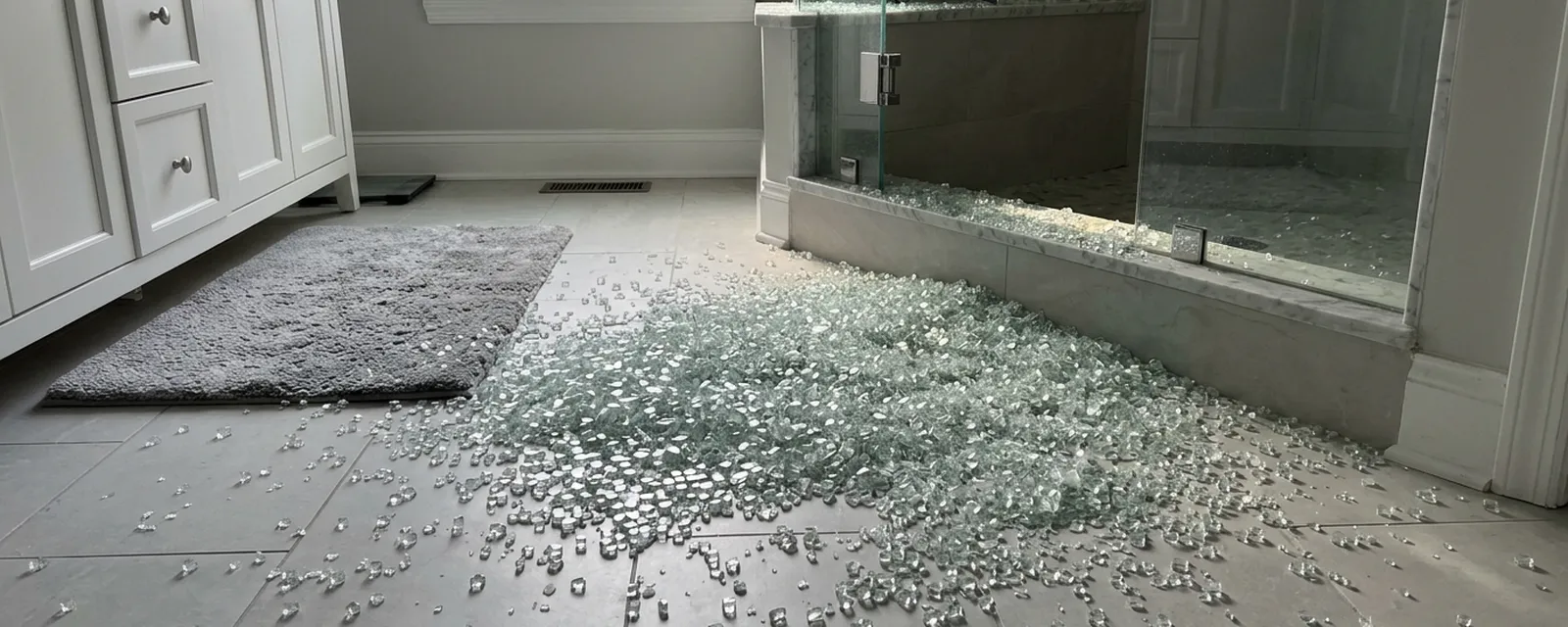
Glass shower doors and panels are everyday fixtures, but they're also held to specific safety rules. Shower glass must be safety glazing, and in practice that almost always means tempered glass. This guide explains what tempered glass is, which federal standards and building codes apply to showers, how to find the safety marking on your glass, and the honest answer to the question many homeowners ask: can it shatter?
What Is Tempered Glass?
Tempered glass starts as ordinary (annealed) glass that is cut to size and finished, then heated and cooled rapidly. This process puts the outer surfaces and edges into compression and the center into tension, which makes the glass much stronger than ordinary glass of the same thickness.
Why It's Called Safety Glass
Tempered glass is considered safety glass because of how it breaks. Instead of forming large, sharp shards, it breaks into many small, relatively blunt pieces. That reduces the risk of serious cuts.
It Must Be Fabricated First
All cutting, notching, hole drilling, and edge work has to happen before tempering. A fabricator notes plainly that tempered glass cannot be cut. This is why shower glass is custom-ordered to exact measurements.
The Federal Standard: CPSC 16 CFR Part 1201
The U.S. Consumer Product Safety Commission (CPSC) regulates glazing in certain home products under 16 CFR Part 1201, the Safety Standard for Architectural Glazing Materials. According to the regulation, it prescribes the safety requirements for glazing materials used or intended for use in a list of products that includes bathtub doors and enclosures and shower doors and enclosures.
The injuries the standard aims to reduce are spelled out, including lacerations, contusions, abrasions, and other injury or death resulting from accidentally falling into or through glazed doors and panels, including shower doors and enclosures.
The standard sets performance requirements, including impact testing. Glazing is rated in categories; Category II is the higher impact level and is the one building codes typically require for shower and tub enclosures.
The Industry Standard: ANSI Z97.1
ANSI Z97.1 is the American National Standard for safety glazing materials used in buildings. It is a voluntary industry standard, but building codes reference it, and the two standards are closely related. In 2016, the CPSC amended Part 1201 to replace its own test procedures with those of the American National Standard for Safety Glazing Materials Used in Buildings, a change requested by the Safety Glazing Certification Council.
You'll often see both standards referenced on the same glass marking.
The Building Code: IRC Section R308
The International Residential Code (IRC) is a model code that many states and municipalities adopt, sometimes with local amendments. Section R308 covers glazing.
Showers and Tubs Are "Hazardous Locations"
Under the 2021 IRC, Section R308.4.5 (Glazing and wet surfaces) classifies glazing in walls, enclosures or fences containing or adjacent to hot tubs, spas, whirlpools, saunas, steam rooms, bathtubs, showers and indoor or outdoor swimming pools where the bottom exposed edge of the glazing is less than 60 inches (1524 mm) measured vertically above any standing or walking surface as a hazardous location. That rule shall apply to single glazing and each pane in multiple glazing.
There's an exception for glazing that is more than 60 inches (1524 mm), measured horizontally, from the water's edge of a bathtub, hot tub, spa, whirlpool or swimming pool or from the edge of a shower, sauna or steam room.
This matters beyond the shower door itself. A window inside or near a shower or tub can also fall into the hazardous-location category.
Glass in Doors
Separately, Section R308.4.1 states that glazing in fixed and operable panels of swinging, sliding and bifold doors shall be considered to be a hazardous location.
Impact Requirements
Section R308.3 requires glazing in hazardous locations to meet impact test requirements. The code text states that glazing shall be tested in accordance with CPSC 16 CFR 1201 and shall comply with the test criteria for Category II unless otherwise indicated in the code's tables.
Codes Vary by Location
Code editions and amendments differ from place to place. New Jersey enforces construction codes through its Uniform Construction Code, which adopts model codes with state-specific changes. For questions about a specific project, your local construction official is the authority.
How to Find the Safety Marking
What the Code Requires
IRC Section R308.1 requires that each pane of glazing in a hazardous location be provided with a manufacturer's designation specifying who applied the designation, the type of glass and the safety glazing standard with which it complies, and that is visible in the final installation. The marking shall be acid etched, sandblasted, ceramic-fired, laser etched, embossed, or be of a type that once applied cannot be removed without being destroyed.
What It Looks Like
Look in a corner of each glass panel for a small, permanent mark, often called a "bug" or "logo." It typically includes:
- The fabricator's or manufacturer's name or identifier
- The word "tempered" or a similar designation
- References to the standards, such as "CPSC 16 CFR 1201" and "ANSI Z97.1"
- A category or class rating
If you can't find a marking on your shower glass, that's worth looking into, especially in an older home or after a previous owner's renovation.
Can Tempered Shower Glass Shatter?
Yes. Tempered glass is much stronger than ordinary glass, but it's not unbreakable. Understanding why it breaks helps you reduce the risk.
Edge and Surface Damage
The most common cause is damage to the glass, especially the edges. One glass fabricator states that the most common cause of glass breakage comes from edge or surface damage during handling. Because the edges are under high stress, a small chip from bumping a tile wall, a hard object, or rough handling during installation can weaken the panel. It may break later, sometimes long after the damage occurred.
Glass-to-Hard-Surface Contact
Glass should never sit directly against tile, stone, or metal. Proper installation uses setting blocks, gaskets, and clearances so the glass isn't stressed. One door manufacturer's instructions warn to never allow the glass to make direct contact with hard surfaces such as ceramic tile, stone, metal or concrete.
Hardware Problems
Loose or misaligned hinges, overtightened clamps, or a door that hits a wall or fixed panel can concentrate stress on the glass.
Nickel Sulfide Inclusions (Rare)
Occasionally, tempered glass breaks with no obvious cause. One known reason is a tiny nickel sulfide impurity in the glass. Vitro Architectural Glass describes nickel sulfide breaks as extremely rare and notes that most North American glass makers have controls that greatly reduce the likelihood of nickel sulfide formation. Vitro also stresses that there is almost always a more common explanation, such as glass edge or surface damage from handling and glazing.
How to Reduce the Risk
- Don't slam the door. Let it close gently.
- Avoid hitting edges. Be careful with hard objects such as shower caddies, bottles, and tools near glass edges.
- Watch for chips. Inspect edges occasionally. A chipped panel should be evaluated by a professional.
- Keep hardware tight and aligned. If the door sags, rubs, or swings unevenly, have it adjusted.
- Use proper installation. Experienced installers use the right setting blocks, clearances, and hardware.
If Your Shower Glass Breaks
Leave the bathroom carefully, wearing shoes, and keep children and pets out. Tempered glass fragments are less sharp than ordinary broken glass but can still cut. Pieces may continue to fall from the hardware. Clean up carefully with gloves, or call a professional to remove the remaining glass safely.
Frequently Asked Questions
Is all shower glass tempered?
Shower enclosures in hazardous locations must use safety glazing that meets code. In residential showers, that is typically tempered glass.
Where is the tempered marking?
It is usually etched or permanently marked in a corner of each glass panel.
Can I cut tempered glass to fit?
No. Tempered glass must be cut and fabricated before tempering.
Is thicker glass required for safety?
Codes focus on safety glazing performance, not a specific thickness for shower doors. Thickness choices are mainly structural and design decisions.
Does tempered glass break on its own?
It's rare. Most breakage traces back to edge damage, stress from hardware or contact, or impact.
For questions about safety glazing in your shower, TruePane Glass is happy to help.
Sources
- eCFR, 16 CFR Part 1201, Safety Standard for Architectural Glazing Materials: www.ecfr.gov
- Federal Register (March 23, 2016), CPSC amendment to 16 CFR Part 1201: www.govinfo.gov
- Boulder County, Publication B30 Safety Glazing (2021 IRC Sections R308.1 and R308.4): bouldercounty.gov
- City of Everett, WA, permit record reproducing IRC Section R308.3: lfportal.everettwa.gov
- Vitro Glass Education Center, "Spontaneous Breakage of Glass": glassed.vitroglazings.com
- Glassonweb, "Spontaneous Breakage": www.glassonweb.com
- Shower door installation and care sheet (Home Depot product PDF): images.homedepot-static.com